 Українська
 Русский
 English
Experts Assess What Will Happen to the Global Economy if Bitcoin Reaches $1 Million
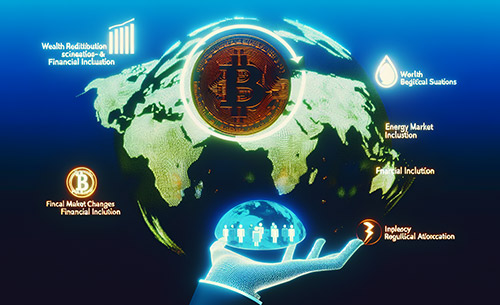
Bitcoin was created as an alternative to depreciating fiat currencies. In August 2025, its price hit a record $124,128. Now, market experts and analysts say that by 2030 BTC could reach $1 million, driven by US debt growth, rising global inflation, and other factors.
Bitcoin was created as an alternative to depreciating fiat currencies. In August 2025, its price hit a record $124,128. Now, market experts and analysts say that by 2030 BTC could reach $1 million, driven by US debt growth, rising global inflation, and other factors.
Such forecasts excite most bitcoiners, dreaming of parking a Lamborghini in front of their mansion. But this assumes today’s purchasing power of $1 million — no one knows what it will be in 2030.
Key questions arise:
-
What will be the relative purchasing power of Bitcoin versus its USD equivalent?
-
What will happen to traditional markets — stocks, real estate, and gold? Will these assets be revalued as capital flows out?
-
What will be the socio-economic impact of capital redistribution, and how will the emergence of “Bitcoin billionaires” affect the middle class?
Sean Yang, Chief Analyst at MEXC Research, was the first to respond. He believes that if BTC does reach $1 million, it will trigger global economic shifts affecting all nations.
First, such a rise would cause a devaluation of the US dollar and the euro, to which most global prices are pegged. Dollar devaluation would spark hyperinflation: purchasing power would plunge, and economies would stagnate. A $1 million Bitcoin in 2030 would not equal $1 million today. The dollar would lose reserve currency status, leading to market redistribution and new trade wars.
Traditional markets would also transform. At $1 million, Bitcoin would no longer serve as a payment method but only as an investment asset concentrated among large investors and funds.
Gold would lose its safe-haven status to Bitcoin. Dollar-denominated company stocks, especially global firms, would fall. Conversely, mining companies and investment funds could surge.
In real estate, owners would prefer BTC payments. This could accelerate real estate tokenization (RWA), creating a new investment market.
Socially, cybercrime would rise sharply: wallet hacks, new viruses, and advanced social engineering. Governments would respond with stricter crypto regulations, shifting from decentralization to centralization.
Weak economies like Argentina, Turkey, and African nations might fully adopt Bitcoin to avoid default, while the US and Europe would be forced to regulate and integrate BTC to maintain financial control.
A $1 million Bitcoin would create a new class of young millionaires and billionaires, forming new elites and shaping global trends. Governments would need to tighten oversight.
Ryan Lee, Lead Analyst at Bitget Research, adds: $1 million in 2030 won’t equal $1 million in 2025. With 3–5% annual inflation, $1 million in 2030 equals about $780k–860k today.
Example: In December 2017, Bitcoin peaked near $20,000. US prices have risen ~31% since then. To preserve purchasing power, BTC should have reached $27,000 — but it grew much more, reinforcing its role as a store of value.
Mikael Abgaryan of EMCD agrees: even at 3–4% inflation, the dollar loses ~20% of its value in five years. Bitcoin, capped at 21 million coins, cannot be inflated.
Key takeaway: today $1 million buys ~10 BTC, but in the future — just 1. Bitcoin is becoming a hedge against systemic dollar devaluation.
A $1 million BTC would reshape markets. Some capital would flow from equities into crypto, but no crash would occur — markets would adapt through ETFs and derivatives. Real estate would surge as Bitcoin millionaires buy luxury homes. Gold would slow but remain a safe-haven, though attention shifts to digital gold.
The middle class would split: BTC holders gaining, others losing in fiat. A new Bitcoin-wealthy elite would emerge.
Thus, a $1 million Bitcoin wouldn’t just be a price milestone but a marker of a new financial era: capital redistribution, new social classes, and financial independence for BTC holders.
Editor: Pereyidenko Ihor