Українська
 Русский
 English
A $3 Trillion Wave of AI Company IPOs Could Divert Capital From Bitcoin as Investors Chase New Market Giants
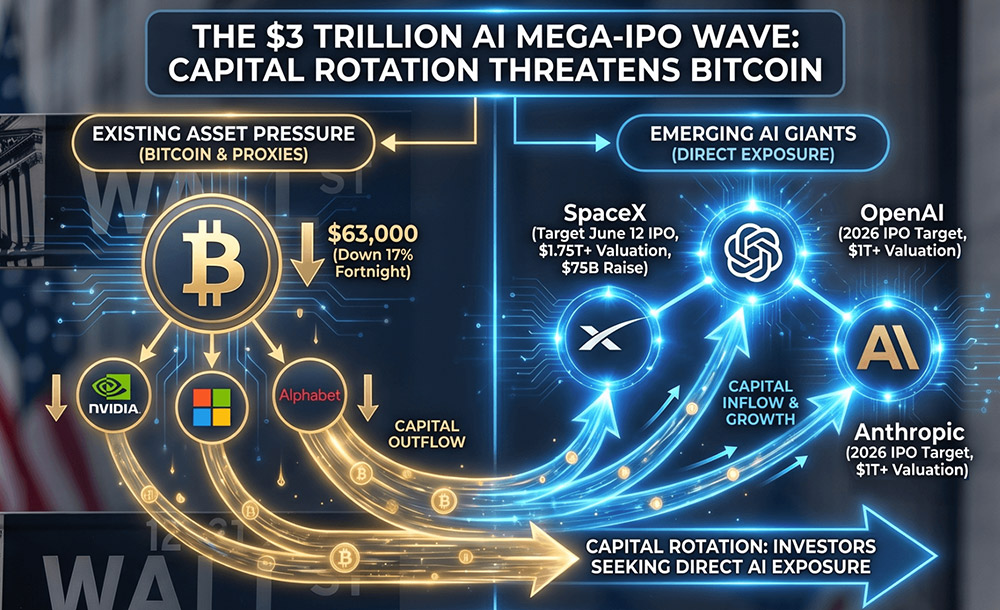
On Thursday, around 12:00 Eastern Daylight Time (EDT), Bitcoin was holding slightly above the $63,000 mark, having lost 17% over the past two weeks, as investors increasingly analysed the potential impact of a historic wave of public listings by artificial intelligence (AI) companies that are expected to begin entering the markets in the coming months.
Key Takeaways
- SpaceX plans to hold an IPO on 12 June, which could raise up to $75 billion at a company valuation of $1.75 trillion.
- OpenAI and Anthropic plan to go public in 2026, which could push the value of AI company IPOs above $3 trillion.
- Bitcoin faces growing competition for capital as investors seek direct exposure to AI market leaders.
Three Mega AI IPOs Could Redirect Billions
At the centre of the discussion are three AI giants that could collectively reach a market value of more than $3 trillion. SpaceX, OpenAI and Anthropic are reportedly preparing for public listings, with SpaceX expected to lead the wave as early as this month.
SpaceX Leads the IPO Wave
Of the three, SpaceX appears to be the closest to entering public markets.
The company, which merged with Elon Musk’s xAI earlier this year, is reportedly planning to debut on Nasdaq on 12 June under the ticker SPCX. Current estimates place the combined enterprise’s value at approximately $1.75 trillion, while some forecasts put it above $2 trillion.
The share offering could raise up to $75 billion, making it one of the largest IPOs in history.
For investors, the company’s appeal extends beyond rockets and satellite broadband. The company now offers public-market access to Starlink, artificial intelligence development through xAI and ambitious plans related to large-scale computing infrastructure.
OpenAI and Anthropic Are Waiting Their Turn
SpaceX may be first, but it is expected to be followed by two of the biggest players in generative AI.
Anthropic, the creator of the Claude family of AI models, recently filed confidential IPO documents on 1 June and plans to enter the public market later this year. The company has become one of the fastest-growing firms in the AI sector, supported by enterprise demand and broad adoption of its software.
OpenAI, the company behind ChatGPT, is also expected to pursue a public listing in the second half of 2026. Rumours suggest it could happen very soon. In private funding rounds, the company was valued at around $852 billion, while some observers forecast that its valuation could exceed $1 trillion once its shares begin trading publicly.
Taken together, these three companies represent a rare opportunity for investors seeking direct exposure to firms that are largely defining the current artificial intelligence boom.
Why Capital Rotation Has Become a Market Theme
The scale of these listings is difficult to ignore.
Institutional investors, pension funds, hedge funds and asset managers seeking meaningful participation in the new listings may need to free up capital from existing positions. Historically, large offerings have often forced portfolio managers to rebalance portfolios, especially when a large amount of fresh equity enters the market over a relatively short period.
Some analysts believe that the most likely source of capital may be existing trades in AI-related stocks, including positions in Nvidia, Microsoft, Alphabet and other technology leaders that have benefited from enthusiasm around AI over the past several years.
Others argue that cryptocurrencies may also face competition for investor capital if market participants view the upcoming listings as the next major growth opportunity. Blockchain and cryptocurrencies have been a dominant theme for many years, but AI is clearly overshadowing the sector for the long term.
Could Bitcoin Feel the Pressure?
This is happening at a time when Bitcoin remains significantly below the highs recorded at the end of 2025, while several cryptocurrency companies have delayed or revised their own IPO plans.
Unlike previous AI investment cycles, investors will soon gain direct access to companies developing advanced AI models, rather than gaining exposure indirectly through cloud-service providers, semiconductor manufacturers or software companies.
This shift could become a powerful magnet for capital, especially if the IPOs generate strong early demand.
Not everyone is convinced that a significant rotation will occur. Many market observers have long noted that, historically, markets have absorbed large IPOs without causing prolonged disruptions in other sectors, while others argue that Bitcoin’s long-term trajectory still depends more on liquidity, monetary policy and adoption trends than on a few public listings.
Nevertheless, the topic has attracted the attention of market participants. Coinshares recently highlighted speculation around potential capital inflows into AI-focused investments and precious metals. At the same time, Strategy Executive Chairman Michael Saylor acknowledged that growing enthusiasm around AI opportunities may be influencing investor behaviour.
Whether these concerns are justified will become clearer once SpaceX shares begin trading. Given that OpenAI and Anthropic are expected to follow later this year, the coming months may become one of the largest real-world tests in history of how capital moves between competing investment narratives.
See also: "New ETFs on BTC, ETH, SOL and XRP Lost $4.4 Billion in 13 Days, With Only HYPE in the Green"