Українська
 Русский
 English
Bitcoin posted its worst first quarter since 2018
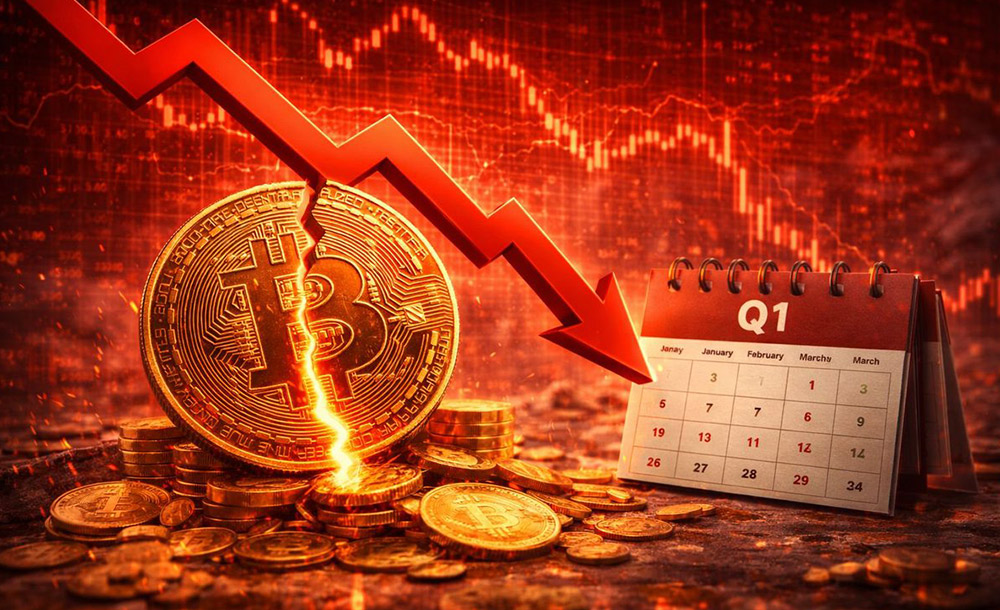
In the first quarter of 2026, the price of the leading cryptocurrency fell by 22.2%, marking its worst start in eight years.
“Digital gold” closed on March 31 at $66,619, according to Yahoo Finance. For comparison, it was trading at $87,508 on January 1. A larger early-year decline was recorded only eight years ago, when the asset dropped by 50% — from $14,112 to $6,973.
The current decline continues the trend from the fourth quarter of 2025, when Bitcoin lost 23%, falling from $114,057 to $87,508. As a result, over the past six months, the cryptocurrency has dropped by more than 40%.

Bitcoin quarterly performance. Source: CoinGlass.
Reasons for the correction
The pullback from all-time highs is largely linked to geopolitical uncertainty caused by escalating tensions in the Middle East. Rising tensions have weakened investor sentiment in both the crypto industry and traditional financial (TradFi) markets.
In addition to macroeconomic factors, outflows from U.S. spot Bitcoin ETFs have also pressured prices. Bitrue’s head of research, Andri Fauzan Adzima, noted that persistently high inflation, the Federal Reserve’s cautious stance, and a broader risk-off environment are worsening the situation.
According to SoSoValue, net outflows from spot ETFs in the first quarter totaled $496.5 million. March inflows of $1.32 billion only partially offset losses of $1.8 billion recorded in the first two months.

ETF inflow and outflow dynamics by month. Source: SoSoValue.
Long-term confidence remains
Despite challenges in the global economy and unstable ETF flows, analysts believe that investor confidence in Bitcoin’s long-term prospects remains intact.
“Institutional participation and adoption trends remain unchanged. This points to cyclical movement rather than a fundamental shift,” said Presto Research analyst Min Jung.
In her view, a reversal of the downtrend in Q2 will require greater macroeconomic clarity, particularly regarding the Middle East situation.
Earlier, Donald Trump stated that the conflict with Iran could end within two to three weeks even without a deal. Meanwhile, Iran continues attacks on neighboring Gulf states. A prime-time address from the U.S. president is expected on April 1 to provide updates on the operation.
“A trend reversal in Q2 will require renewed ETF inflows, clear regulatory progress in the U.S. crypto industry, and a shift toward a more accommodative monetary policy,” said LVRG research director Nick Ruck in a comment to The Block.
At the time of writing, Bitcoin is trading around $68,800, up 2.9% over the past 24 hours, according to CoinGecko.
Notably, JPMorgan analysts have identified Bitcoin as a leading safe-haven asset amid the conflict in Iran.
See also: "Bitcoin ETFs rebound with $69M inflows, while Ethereum breaks its losing streak"