 Українська
 Русский
 English
24/12/25 01:04 UTC-04
Mining company stocks set to finish 2025 in the green
Eight out of the ten largest bitcoin miners are set to end the year with solid gains, ranging from 12% at Core Scientific to 328% at Iren Limited.


Eight out of the ten largest bitcoin miners are set to end the year with solid gains, ranging from 12% at Core Scientific to 328% at Iren Limited.
Bitcoin miners in China’s Xinjiang province are disconnecting from the network following another wave of crackdowns by the authorities. As of now, up to 400,000 mining machines have already been taken offline, leading to a decline in the hashrate.
According to a new report from JPMorgan analysts Reginald Smith and Charles Pearce, Bitcoin miners are facing some of the most challenging operating conditions in recent years.
Starting January 1, 2026, cryptocurrency mining and trading in Turkmenistan will become fully legal. Local media reported that the country’s president, Serdar Berdimuhamedow, has signed a new law that establishes regulations for issuing, storing, and trading digital assets.
One of the key parameters in the network of the first cryptocurrency has decreased for the second consecutive time. On the morning of November 27, Bitcoin’s mining difficulty fell by 1.95%. According to Cloverpool, the indicator dropped to 149.3 T (trillion). This means that miners now need to compute about 149 trillion hash functions on average to add a single block to the Bitcoin network and receive the reward of 3.125 BTC (around $285,000 at the current rate).
Tether has officially confirmed that it is shutting down its cryptocurrency mining operations in Uruguay and laying off 30 of its 38 employees. The reason is excessively high electricity costs and uncompetitive tariffs.
The cryptocurrency Zcash (ZEC) continues to hold strong and is trading at $585. Despite a weekly decline of 18%, the privacy coin is up 108% over the past 30 days. This surge has pushed the Zcash network to the top of the PoW segment, and the Equihash algorithm in ZEC is now more profitable than Bitcoin’s SHA256.
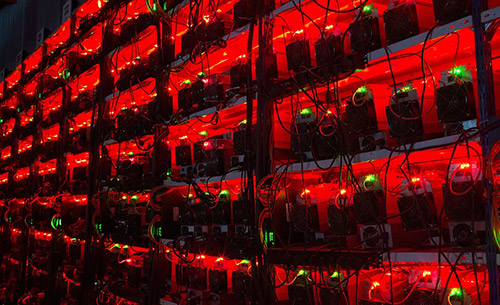
Expert calls the revival of crypto mining in the PRC “one of the most important signals” for the market. Crypto mining in China is experiencing a “quiet revival.” The country’s share of global hashrate has risen to 14%, Reuters reports.
Trump’s net worth increased by $3 billion from September to September, allowing the politician to take 201st place on Forbes’ list of the 400 richest Americans. The growth was driven by the Trump family’s investments in cryptocurrency, the magazine reports.
The Bitcoin market has encountered a sharp increase in pressure from miners, as net flows from Binance Pool have moved into a deep negative zone. Data shows that BTC miners are transferring significant volumes of coins to exchanges, which usually indicates preparation for sales or active profit-taking. At the same time, the price of Bitcoin fell from $120,000 to $81,000, and aggressive outflows from miners have noticeably increased supply on trading platforms. Such behavior indicates growing stress among industry participants.
Bitmain has launched a public auction for its Antminer S19k Pro units with a starting price of $5.5 per TH/s, as the company seeks to clear inventory in a challenging market for bitcoin mining hardware.
Malaysia’s national energy company, Tenaga Nasional Berhad (TNB), reported losses of more than $1.1 billion related to electricity theft for cryptocurrency mining from 2020 to August 2025. The Ministry of Energy stated that during this period, 13,827 facilities were found to be illegally connected to the grid for digital asset mining. The agency emphasizes that such activities threaten the stability of the power system, public safety, and the country’s economy.
Despite Bitcoin (BTC) dropping to around ~$91,000, miners are not panicking — they are acting strategically. According to CryptoQuant, the main wave of selling is already behind us.
In November, miners became among the most active users of the Binance cryptocurrency exchange, transferring 71,000 bitcoins to the platform. The maximum one-day deposit received by Binance amounted to 12,564 BTC.
Thiel acknowledged that many miners are currently struggling due to fierce competition, increasing electricity demand, and declining profitability. The MARA CEO described mining as a “zero-sum game,” explaining that it becomes harder for participants as more people join in. This means that due to the reduction in miner rewards (halving), which occurs every four years, miners earn less profit, while their electricity costs remain the same — and those are only the minimal expenses.
A key profitability metric — the hashprice — has dropped to levels where many small miners find it unprofitable to mine Bitcoin (BTC), raising questions about the sustainability of the entire industry.